As a correspondent in the Vietnam War, Michael Herr experienced first hand the Tet Offensive, the siege of Khe Sanh, and the battle of Hue. In Dispatches, which I believe was first published in 1977, Herr describes multiple facets of the war as seen through his eyes, as filtered through his consciousness, and as wrung through his conscience.
Much of what Dispatches describes is not news to me; the Vietnam War has been something of a hot topic since I was a little girl listening to the casualty counts on the evening news. However, Herr's account is so rewarding, so riveting, that I hated to put it down. Combining rich descriptions of the milieu - landscape, city, or awesome, ghastly destruction - with unforgettable portraits of grunts and officials, fellow correspondents and super sappers, he fills in the outlines of what I already knew with vivid color.
The themes of the book are military malpractice, political bullshit, and, of course and above all, death. Also, Herr's (and everyone else's) love-hate relationship with war. And his attempt to reconcile the unreconcilable. And the sheer inevitability of it all. He writes, "There'd been nothing there that hadn't already existed here, coiled up and waiting, back in the World."
Epic and intimate, humorous and horrible, Herr's account is never simplistic and almost always fascinating. The only part that falls short for me is the section about his colleagues in the press corps; though many of the portraits are well drawn, for me they rarely measure up to those in the remaining chapters of the narrative.
Still, I enthusiastically recommend this book for those interested in the Vietnam War, and for those interested in war generally. Men and war. Yep, men and war.
Showing posts with label death. Show all posts
Showing posts with label death. Show all posts
Tuesday, June 19, 2018

Monday, September 24, 2007
What will you take with you?
Thanks to the wonderful people at my local library, I finally got my hands on a copy of this book--the first edition, that is, not the second, although I suspect I may have to purchase the latter at some point. It's a big, big book, with lots of information that's new to me. I appreciate Price’s introduction to scholarship on the noaidi - the "Sámi shaman." I'm still 100 pages shy of the finish, and I feel like I'm reading a detective novel, trying to make some guesses of my own in advance of the thrilling conclusion. I just read about the Sámi view of the Northern Lights and it kind of blew my mind. I woke up this morning with it all spinning around in my head.
In the meantime, though, the burials have really captured my imagination. Archaeologist Dr. Price discusses several Norse and Sámi graves in connection with his topic. They include intriguing assemblages of grave goods, and show evidence of what must have been profound, meaningful funerary rites.
He has singled out graves that he believes may house the remains of sorcerers or spiritual specialists, and as these people operated toward the outer limits of human society, their graves are bound to be extraordinary. Still, it seems to me that graves in general represent a category that is fair game for both religious symbolism and intimate associations.

The lack of standardizaton has posed problems for those trying to "make sense of" these graves in the light of known mythologies. Ellis-Davidson simply wrote that differences indicate the presence of strong family traditions. Some contemporary scholars look at regional patterns in burial preferences as one way of trying to delineate different political/social/religious spheres of influence within Scandinavia of the period. I don’t have enormous experience in this area, but in reading accounts of graves here and there, exact parallels among them seem to be relatively rare. Perhaps the more "run-of-the-mill" graves simply don't get written about. The ones on the farther reaches of the bell curve, however, seem to be numerous and remarkable.

If, however, most of our burials today seem unremarkable when compared with those of the past, it is perhaps partly because we entrust them to corporate entities. What if, instead (and I’m not suggesting that we actually do this), we buried our own loved ones ourselves? Not only would we be forced to plan every aspect of the disposal of their physical being, but we would also have a more intimate, tactile, and perhaps, profound, association with death itself. How would this impact our view of death? How would this be manifested in our choices of grave types, sites, or grave goods (or lack thereof)? Would our final resting situations remain as uniform as they are today? Or would our choices be as baffling to future archaeologists as those of our ancestors are to us?

References
Ellis Davidson, Hilda. The Lost Beliefs of Northern Europe. London and New York: Routledge, 1993.
Price, Neil S. The Viking Way: Religion and War in Late Iron Age Scandinavia. Uppsala, 2002.
Söderberg, Bengt. Aristokratiskt rum och gränsöverskridande. Stockholm: Riksantikvarieämbetets förlag, 2005.
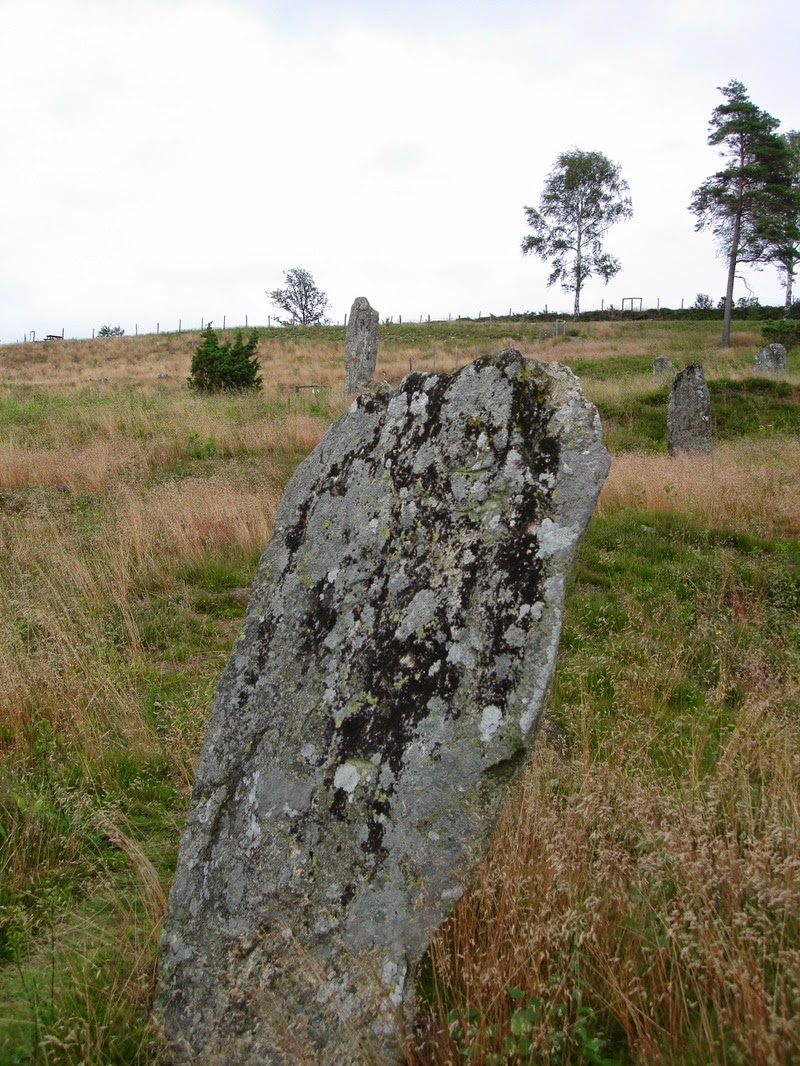
Photos: A Viking-age grave at Li, Fjärås, Sweden; A Bronze-age stenhög (stone burial cairn) overlooks the sea from the Swedish west coast; More Viking-age graves at Li; A kyrkogård (churchyard), Kungsbacka, Sweden. Click the photos to enlarge.
Subscribe to:
Comments (Atom)